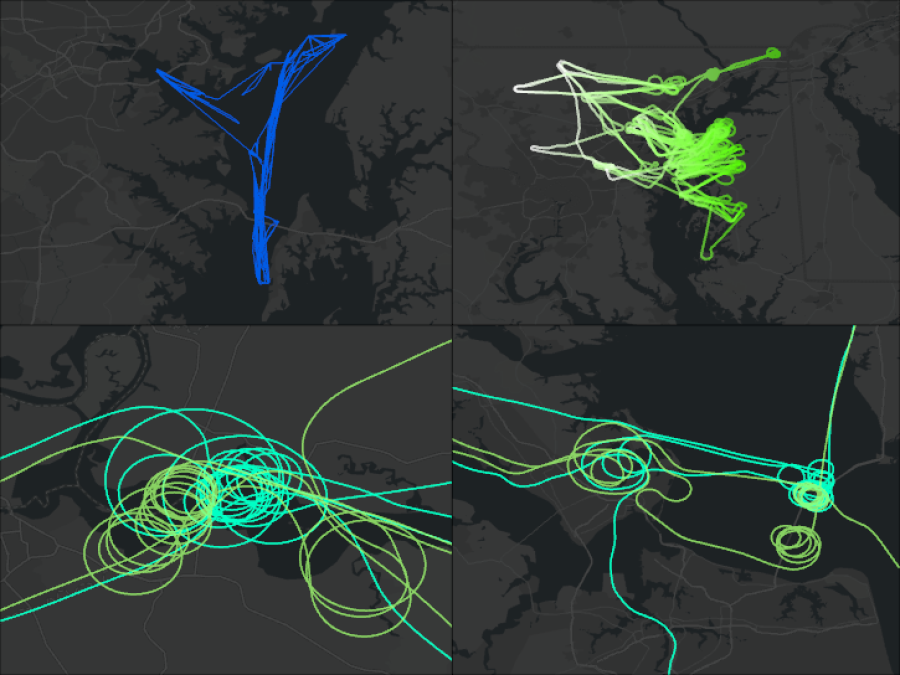
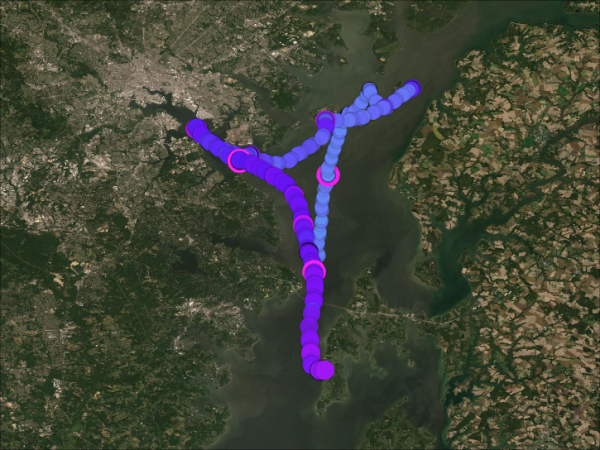
OWLETS Flight and Boat Paths
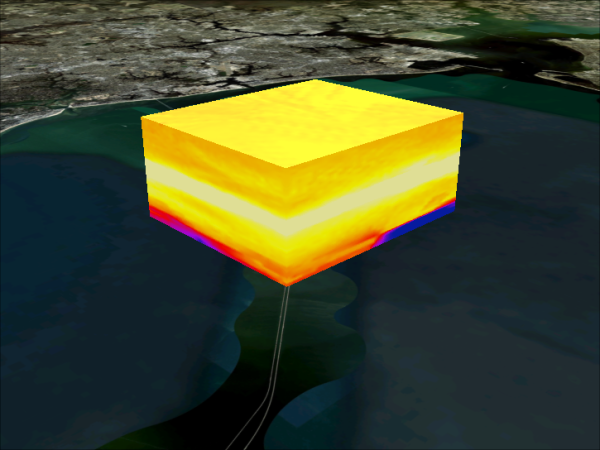
Data Cube of CO2 data above the Chesapeake Bay bridge Tunnel from the OWLETS campaign
Ozone Data from OWLETS

OWLETS

Ozone Water–Land Environmental Transition Study

Coastal regions have typically posed a challenge for air quality researchers due to a lack of measurements available over water and water-land boundary transitions. Supported by NASA’s Science Innovation Fund (SIF), the Ozone Water-Land Environmental Transition Study (OWLETS) field campaign examined ozone concentrations and gradients over the Chesapeake Bay from July 5, 2017 – August 3, 2017, with twelve intensive measurement days occurring during this time period. OWLETS utilized a unique combination of instrumentation, including aircraft, TOLNet ozone lidars (NASA Goddard Space Flight Center Tropospheric Ozone Differential Absorption Lidar and NASA Langley Research Center Mobile Ozone Lidar), UAV/drones, ozonesondes, AERONET sun photometers, and mobile and ship-based measurements, to characterize the land-water differences in ozone and other pollutants. 

Principal Investigator

Timothy Berkoff, John Sullivan

Data Centers

ASDC

Two main research sites were established as part of the campaign: an over-land site at NASA LaRC, and an over-water site at the Chesapeake Bay Bridge Tunnel. These two research sites were established to provide synchronous vertical measurements of meteorology and pollutants over water and over land. In combination with mobile observations between the two sites, pollutant gradients were able to be observed and used to better understand the fundamental processes occurring at the land-water interface. 

OWLETS-2 was completed from June 6, 2018 – July 6, 2018 in the upper Chesapeake Bay region. Research sites were established at the University of Maryland, Baltimore County (UMBC), Hart Miller Island (HMI), and Howard University Beltsville (HUBV), with HMI representing the over-water location and UMBC and HUBV representing the over-land sites. Similar measurements were carried out to further characterize water-land gradients in the upper Chesapeake Bay. The measurements completed during OWLETS are of importance in enhancing air quality models, and improving future satellite retrievals, particularly, NASA’s Tropospheric Emissions: Monitoring of Pollution, which is scheduled to launch in 2022.

  • Examine ozone concentrations and gradients over the Chesapeake Bay

Deployments

OWLETS scientists collected data using a variety of platforms, including airborne, mobile, and ground-based. These measurements collected with the instruments on the platforms were used in conjunction with various satellite data. The following table goes briefly into the instruments and payloads used in OWLETS-1:

PlatformInstrument(s)
Short Brothers C-23 SherpaCompact Airborne Formaldehyde Experiment (CAFE)
Generic-Chemistry Related Sensors (Gen-Chem)
LI-COR Quantum Sensors
Gas Chromatograph/Mass Spectrometry (GC-MS)
Integrated Cavity Output Spectrometer (ICOS)
Whole Air Sampler (WAS)
Generic-Atmospheric State (Gen-AtmsState)
Chemiluminescence Instrument (NOx/NOxy)
Los Gatos Research Greenhouse Gas Analyzer (GGA)
Geostationary Trace gas and Aerosol Sensor Optimization Spectrometer (GeoTASO)
2B Technologies Ozone Monitor
Ground Station/Field SitePandora Spectrometer System (Pandora)
Langley Mobile Ozone Lidar (LMOL)
NASA Goddard Space Flight Center TRO-Pospheric Ozone Differential Absorption Lidar (GSFC TROPOZ DIAL)
SondesOzonesondes
ModelsGoddard Earth Observing System (GEOS) Computer Models

OWLETS scientists collected data using a variety of platforms, including airborne, mobile, and ground-based. These measurements collected with the instruments on the platforms were used in conjunction with various satellite data. The following table goes briefly into the instruments and payloads used in OWLETS-2:
 

PlatformsInstrument(s)
University of Maryland Cessna 402B Research Aircraft (UMD Cessna)Picarro Gas Analyzer (Picarro)
TSI-3563 Nephelometer
3-Wavelength Particle Soot Absorption Photometer (PSAP)
Aethalometer
Thermo Scientific Gas Analyzer
Los Gatos Research Cavity Ringdown Spectroscopy (LGR CRDS)
Dassault HU-25A Guardian (HU-25A)Geostationary Trace gas and Aerosol Sensor Optimization (GeoTASO)
Research Vessel Smithsonian Environmental Research Center (R/V SERC)Pandora Spectrometer System (Pandora)
Generic-Chemistry Related Sensors (Gen-Chemistry)
Ceilometer
Ground Stations/Field SitesLangley Mobile Ozone Lidar (LMOL)
NASA Goddard Space Flight Center TRO-Pospheric Ozone Differential Absorption Lidar (GSFC DIAL)
Light Detection and Ranging (LIDAR)
Ceilometers
Particle-IntBMI Particle-Into-Liquid Sampler and ICS-3000 Ion Chromatography System (PILS/IC)
Picarro G2401 Gas Concentration Analyzer (Picarro G2401)
LGR CRDS
SondesOzonesondes