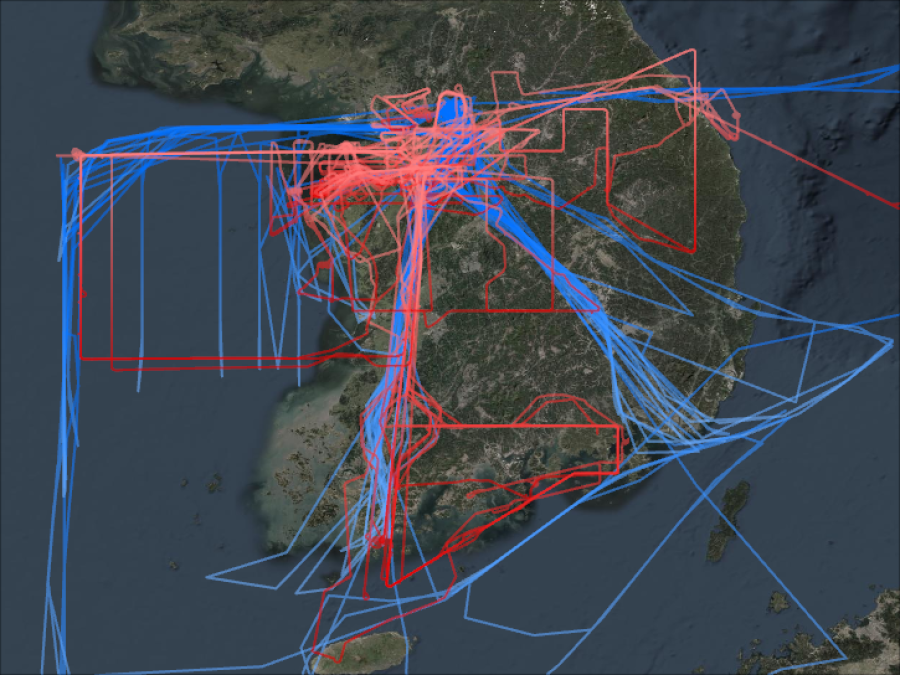
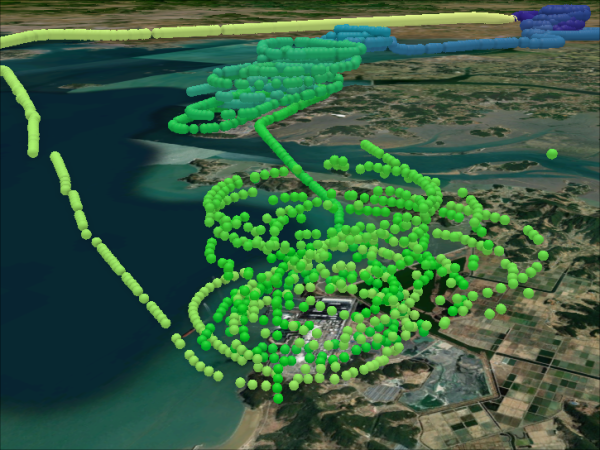

KORUS-AQ Flightpaths
3D Flightpath of KORUS-AQ
Image of smokestacks with plumes of smoke coming out of them

KORUS-AQ

Korea United States Air Quality Study

Data Centers

ASDC

The KORUS-AQ field study was conducted in South Korea during May-June, 2016. The study was jointly sponsored by NASA and Korea’s National Institute of Environmental Research (NIER). 

The primary objectives were to investigate the factors controlling air quality in Korea (e.g., local emissions, chemical processes, and transboundary transport) and to assess future air quality observing strategies incorporating geostationary satellite observations. To achieve these science objectives, KORUS-AQ adopted a highly coordinated sampling strategy involved surface and airborne measurements including both in-situ and remote sensing instruments.

Surface observations provided details on ground-level air quality conditions while airborne sampling provided an assessment of conditions aloft relevant to satellite observations and necessary to understand the role of emissions, chemistry, and dynamics in determining air quality outcomes. The sampling region covers the South Korean peninsula and surrounding waters with a primary focus on the Seoul Metropolitan Area. 

Airborne sampling was primarily conducted from near surface to about 8 km with extensive profiling to characterize the vertical distribution of pollutants and their precursors. The airborne observational data were collected from three aircraft platforms: the NASA DC-8, NASA B-200, and Hanseo King Air. Surface measurements were conducted from 16 ground sites and 2 ships: R/V Onnuri and R/V Jang Mok.

The major data products collected from both the ground and air include in-situ measurements of trace gases (e.g., ozone, reactive nitrogen species, carbon monoxide and dioxide, methane, non-methane and oxygenated hydrocarbon species), aerosols (e.g., microphysical and optical properties and chemical composition), active remote sensing of ozone and aerosols, and passive remote sensing of NO2, CH2O, and O3 column densities. 

These data products support research focused on examining the impact of photochemistry and transport on ozone and aerosols, evaluating emissions inventories, and assessing the potential use of satellite observations in air quality studies.

  • Investigate the factors controlling air quality in Korea (e.g., local emissions, chemical processes, and transboundary transport) 
  • Assess future air quality observing strategies incorporating geostationary satellite observations
PlatformsInstruments
NASA DC-8Computer
AEROSOL MASS SPECTROMETER (AMS)
Aerodynamic Particle Sizer (APS)
TSI Condensation Particle Counter 3010 Manufactured by TSI Inc.
LASER SPECTROMETER
3-Wavelength Particle Soot Absorption Photometer Manufactured by Radiance Research (PSAP)
TSI-3563 Nephelometer
Scanning Mobility Particle Sizer (SMPS)
ION CHROMATOGRAPHS
Liquid Waveguide Capillary Cells (LWCC)
Spectrometers for Sky-Scanning, Sun-Tracking Atmospheric Research (4STAR)
CCN Counter (CCN)
Cloud Particle Spectrometer with Polarized Detection (CPSPD)
Thermodenuder
Differential Absorption Lidar (DIAL)
CCD-based Actinic Flux Spectroradiometer (CAFS)
Diode Laser Hygrometer developed by NASA LaRC (DLH)
Total Water Instrument: Closed-path Laser Hygrometer 2 (CLH2)
HYGROMETERS
Global Positioning System (GPS)
LI-6252 CO2 Analyzer
Gas Chromatograph/Mass Spectrometry (GC-MS)
Thermal Dissociation Laser Induced Fluorescents developed by University of California, Berkley (TD-LIF)
Differential Absorption CO, CH4, N2O Measurements (DACOM)
Compact Atmospheric Multispecies Spectrometer (CAMS)
Spectrometers for Sky-Scanning, Sun-Tracking Atmospheric Research (4STAR)
Chemical Ionization Mass Spectrometer (CIMS)
Chemical Ionization Time-of-Flight Mass Spectrometer (CIT-ToF-CIMS)
Airborne Cavity Enhanced Spectrometer (ACES)
CHEMILUMINESCENCE
Proton Transfer Mass Spectrometer (PTR-MS)
Beechcraft King AirNASA Compact Airborne Formaldehyde Experiment (CAFE)
Los Gatos Research CO/CO2/H2O Analyzer (LGR)
Cavity Attenuated Phase Shift Nitrogen Dioxide Analyzer (CAPS NO2 Analyzer)
Aerolaser AL5002 CO Monitor
Teledyne Advanced Pollution Instrumentation Model T400 Ozone Analyzer
Thermo Scientific Model 43i SO2 Analyzer
B-200Geostationary Trace gas and Aerosol Sensor Optimization (GeoTASO)
Applanix POSAV
Field Campaign Ground SiteCEILOMETERS
Cloud, Aerosol, Precipitation Spectrometer (CAPS)
2B Technologies Ozone Monitor
Aeroqual Series 500 Portable Air Quality Monitor
Aerodyne Mini-Tunable Infrared Laser Direct Absorption Spectroscopy (TILDAS)
Differential Absorption Lidar (DIAL)
Pandora Spectrometer Instrument
OZONESONDES
University of Maryland Cessna 402BGlobal Positioning System (GPS)
Los Gatos Research Cavity Ringdown Spectroscopy (LGR CRDS)
TECO Model 43C SO2 Analyzer
Picarro G2401 Gas Concentration Analyzer
AETHALOMETER
3-Wavelength Particle Soot Absorption Photometer Manufactured by Radiance Research
R/V OnnuriPandora Spectrometer Instrument
Spectral Aerosol Extinction (SpEx)
AEROSOL MASS SPECTROMETER (AMS)
SUN PHOTOMETERS
GAS SENSORS
R/V JangMokThermo Scientific Model 49i Ozone Analyzer
Thermo Scientific Model 42i-TL Trace Level NOx Analyzer
Thermo Scientific Model 48i-TLE Enhanced Trace Level CO Analyzer
Thermo Scientific Model 43i SO2 Analyzer
WIND MONITOR
Global Positioning System (GPS)