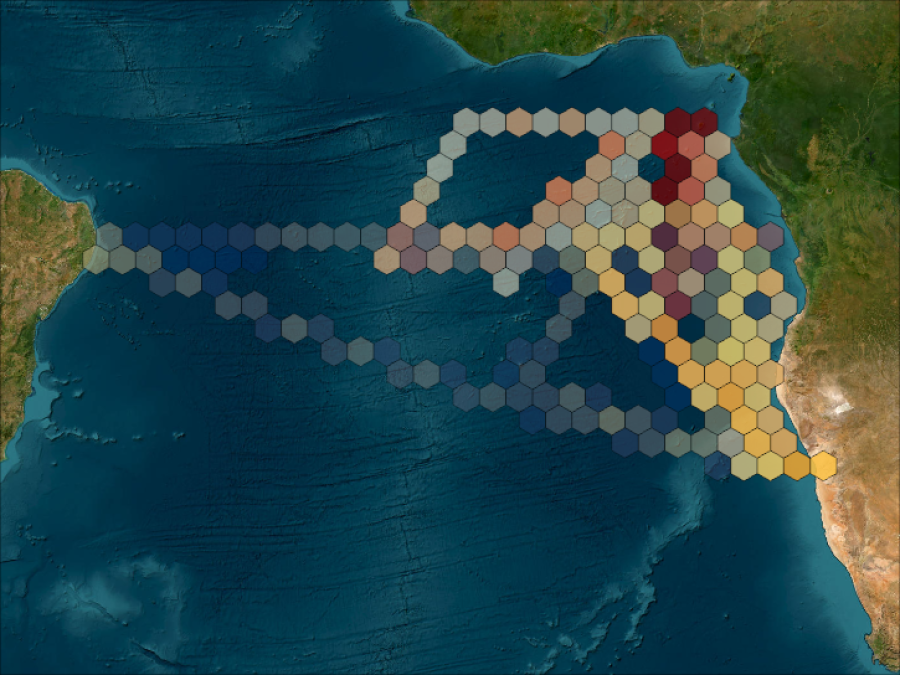
Hexbins of data collection locations during the ORACLES Campaign
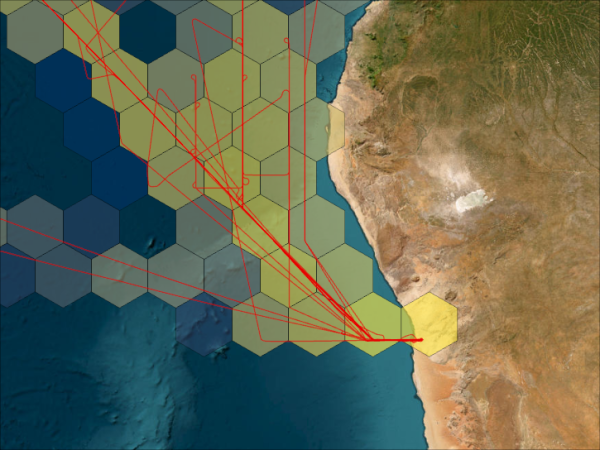
ER-2 Flightpaths and Hexbins of Data Collection Locations of the ORACLES Camapign
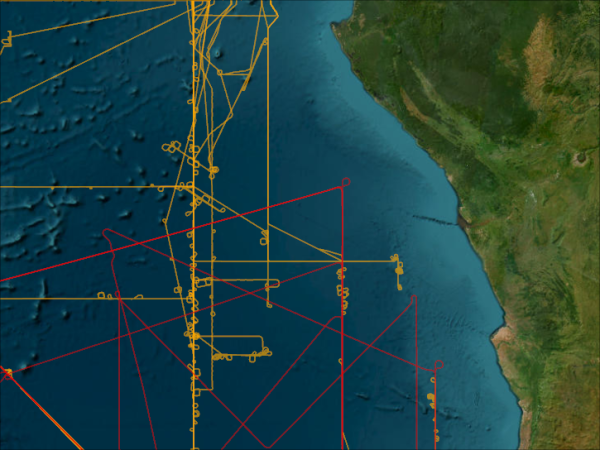
P3-B and ER-2 Flightpaths from the ORACLES Campaign

ORACLES

ObseRvations of Aerosols above CLouds and their intEractionS

Data Centers

ASDC

Southern Africa produces almost one-third of the Earth’s biomass burning aerosol particles. The ORACLES (ObseRvations of Aerosols above CLouds and their intEractionS) experiment was a five year investigation with three intensive observation periods (August 19, 2016 – October 27, 2016; August 1, 2017 – September 4, 2017; September 21, 2018 – October 27, 2018) and was designed to study key processes that determine the climate impacts of African biomass burning aerosols. 

ORACLES provided multi-year airborne observations over the complete vertical column of the key parameters that drive aerosol-cloud interactions in the southeast Atlantic, an area with some of the largest inter-model differences in aerosol forcing assessments. These inter-model differences in aerosol and cloud distributions, as well as their combined climatic effects in the SE Atlantic are partly due to the persistence of aerosols above clouds. 

The varying separation of cloud and aerosol layers sampled during ORACLES allow for a process-oriented understanding of how variations in radiative heating profiles impact cloud properties, which is expected to improve model simulations for other remote regions experience long-range aerosol transport above clouds. 

ORACLES utilized two NASA aircraft, the P-3 and ER-2. The P-3 was used as a low-flying platform for simultaneous in situ and remote sensing measurements of aerosols and clouds in all three campaigns, supplemented by ER-2 remote sensing in 2016. ER-2 observations will be used to enhance satellite-based remote sensing by resolving variability within a particular scene, and by guiding the development of new and improved remote sensing techniques.

For more information regarding the Airborne Multi-angle SpectroPolarimetric Imager (AirMSPI) data collected during ORACLES, please refer to: AirMSPI ORACLES Ellipsoid Data, AirMSPI ORACLES Terrain Data, and AirMSPI Cloud Droplet Size and Cloud Optical Depth Product.

  • Study key processes that determine the climate impacts of African biomass burning aerosols
PlatformsInstruments
NASA ER-2Computer
HSRL-2
Research Scanning Polarimeter - 2 (RSP-2)
Global Positioning System
HYGROMETERS
PRESSURE TRANSDUCERS
PITOT-STATIC SYSTEM
TEMPERATURE SENSORS
Solar Spectral Flux Radiometers (SSFR)
NASA P-3Computer
Spectrometers for Sky-Scanning, Sun-Tracking Atmospheric Research (4STAR)
3-Wavelength Particle Soot Absorption Photometer Manufactured by Radiance Research (PSAP)
CCN Counter
TSI Condensation Particle Counter 3010 Manufactured by TSI Inc.
TSI Condensation Particle Counter 3025 Manufactured by TSI Inc.
Photothermal Interferometer (PTI)
TSI-3563 Nephelometer
Single Particle Soot Photometer Manufactured by Droplet Measurement Technologies (DMT SP2)
AEROSOL MASS SPECTROMETER (AMS)
Passive-Cavity Aerosol Spectrometer Probe (PCASP)
Ultra-High Sensitivity Aerosol Spectrometer Manufactured by Droplet Measurement Technologies (DMT UHSAS)
Ultra-High Sensitivity Aerosol Spectrometer (UHSAS)
Aerodynamic Particle Sizer (APS)
Research Scanning Polarimeter - 2 (RSP-2)
Research Scanning Polarimeter - 1 (RSP-1)
HSRL-2
Advanced Microwave Precipitation Radiometer (AMPR)
Third Generation Airborne Precipitation Radar (APR-3)
Flight Probe Dual Range Phase Doppler Interferometer (FPDR-PDI)
2D-STEREO PARTICLE PROBE (2DS)
Cloud, Aerosol, Precipitation Spectrometer (CAPS)
Cloud and Aerosol Spectrometer (CAS)
Cloud Imaging Probe (CIP)
High Volume Particle Sampler (HVPS)
Cloud Droplet Probe (CDP)
Los Gatos Research CO/CO2/H2O Analyzer (LGR)
Water Vapor Isotopic Analyzer (WVISO)
Global Positioning System (GPS)
HYGROMETERS
PRESSURE TRANSDUCERS
PITOT-STATIC SYSTEM
TEMPERATURE SENSORS
Solar Spectral Flux Radiometers (SSFR)
OZONE MONITORS