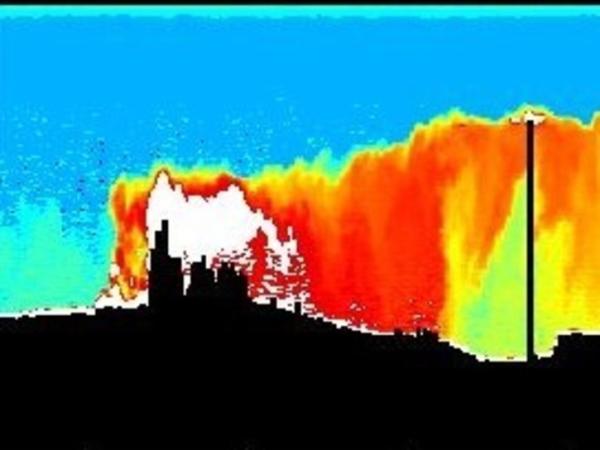
FIREX-AQ Flightpaths
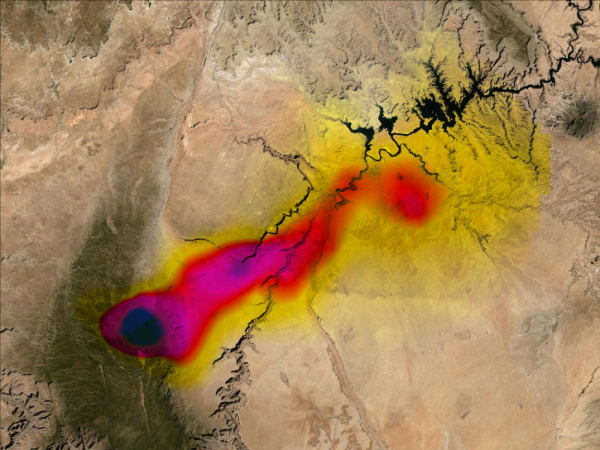
CO data from the FIREX-AQ Campaign
FIREX-AQ Lidar Data

FIREX-AQ

Fire Influence on Regional to Global Environments and Air Quality

Data Centers

ASDC

The Fire Influence on Regional to Global Environments and Air Quality (FIREX-AQ) campaign was a NOAA/NASA interagency intensive study of North American fires to gain an understanding on the integrated impact of the fire emissions on the tropospheric chemistry and composition and to assess the satellite’s capability for detecting fires and estimating fire emissions. 

The overarching goal of FIREX-AQ was to provide measurements of trace gas and aerosol emissions for wildfires and prescribed fires in great detail, relate them to fuel and fire conditions at the point of emission, characterize the conditions relating to plume rise, follow plumes downwind to understand chemical transformation and air quality impacts, and assess efficacy of satellite detections for estimating the emissions from sampled fires.

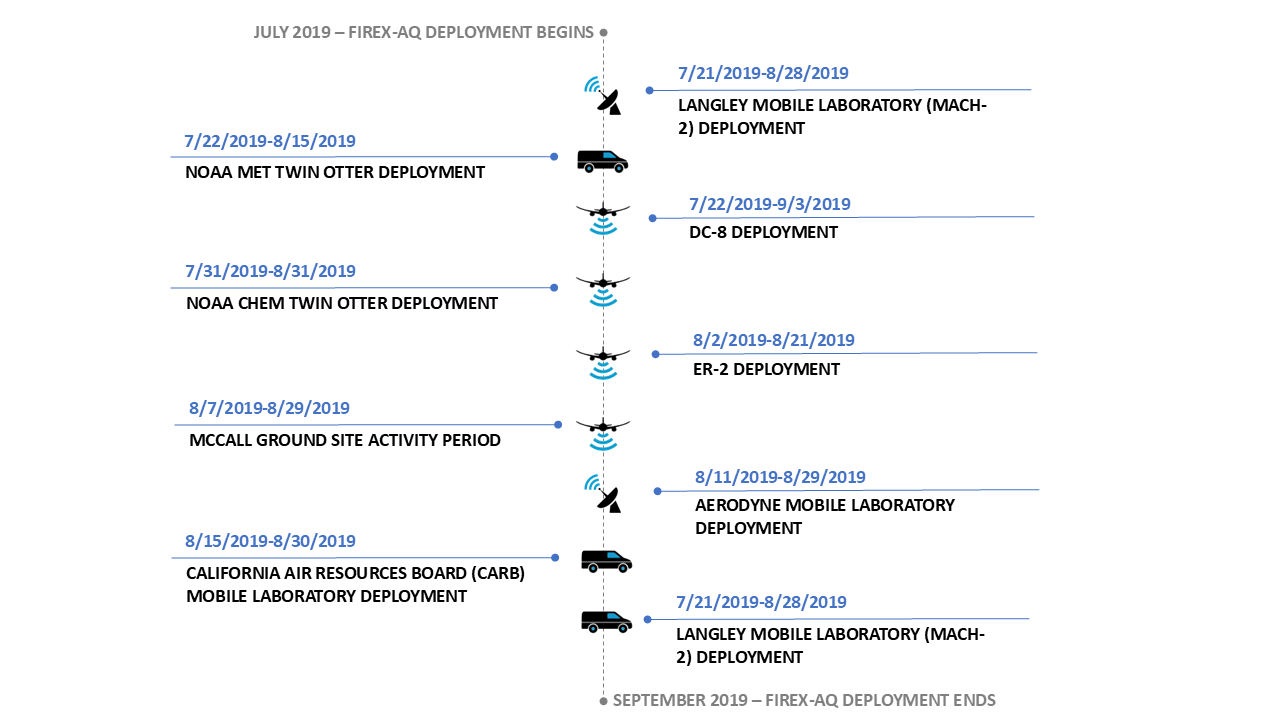
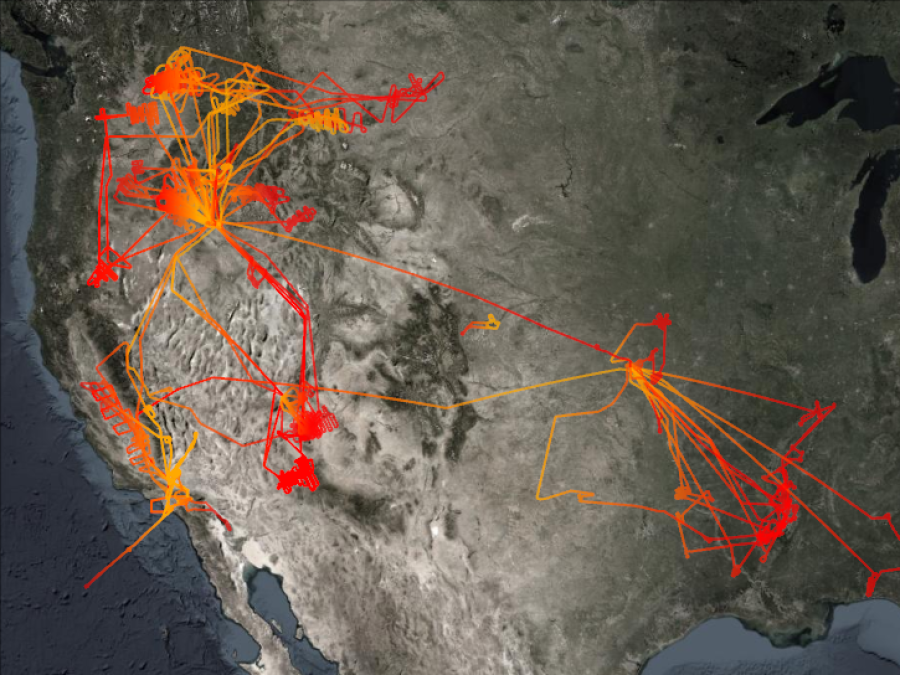
Completed during summer 2019, FIREX-AQ utilized a combination of instrumented airplanes, satellites, and ground-based instrumentation. Detailed fire plume sampling was carried out by the NASA DC-8 aircraft, which had a comprehensive instrument payload capable of measuring over 200 trace gas species, as well as aerosol microphysical, optical, and chemical properties. The DC-8 aircraft completed 23 science flights, including 15 flights from Boise, Idaho and 8 flights from Salina, Kansas. NASA’s ER-2 completed 11 flights, partially in support of the FIREX-AQ effort. The ER-2 payload was made up of 8 satellite analog instruments and provided critical fire information, including fire temperature, fire plume heights, and vegetation/soil albedo information. 

NOAA provided the NOAA-CHEM Twin Otter and the NOAA-MET Twin Otter aircraft to measure chemical processing in the lofted plumes of Western wildfires. The NOAA-CHEM Twin Otter focused on nighttime plume chemistry, from which data is archived at the NASA Atmospheric Science Data Center (ASDC). The NOAA-MET Twin Otter collected measurements of air movements at fire boundaries with the goal of understanding the local weather impacts of fires and the movement patterns of fires. 

Additionally, a ground-based station in McCall, Idaho and several mobile laboratories provided in-situ measurements of aerosol microphysical and optical properties, aerosol chemical compositions, and trace gas species.

For more information regarding the Airborne Multi-angle SpectroPolarimetric Imager (AirMSPI) data collected during FIREX-AQ, please refer to: AirMSPI FIREX-AQ Terrain-Projected Georegistered Radiance Product.

For more information regarding the MASTER dataset for FIREX-AQ, please refer to the ORNL site: ORNL MASTER FIREX-AQ Data.

  • Collect measurements of trace gas and aerosol emissions from wildfires and prescribed fires.
  • Relate measurements to fuel and fire conditions at point of emission.
  • Characterize conditions relating to plume rise.
  • Follow plumes downwind to understand chemical transformation and air quality impacts.
  • Assess efficacy of satellite detections for estimating the emissions from sampled fires.
Image

The deployment on the platforms detailed above for FIREX-AQ offered rare opportunities to capture in-situ and remote sensing measurements from fires. Throughout FIREX-AQ, the multiple platforms captured many plumes from hundreds of fires, providing a comprehensive set of measurements. An example of one of these fires was the "Castle" fire sampled through August 12-13, during which FIREX-AQ scientists explored the chemical composition, evolution, and transport of emissions in plumes throughout the fire's lifespan. Additional details about the sampling of the "Castle" fires are available in a NASA Earth Observatory article.

Another event of interest was the capture of the formation of a pyrocumulonimbus cloud (PyroCb) from the "Williams Flat" fire on August 8, 2019. PyroCbs occur when heat and moisture created from fires lead to thunderstorms and are capable of sending aerosols high into the atmosphere, with some events injecting aerosols directly into the stratosphere. The "Williams Flats" fire produced a large pyroCb that FIREX-AQ scientists were able to capture on the day's DC-8 science flight. The sampling conducted during the flight was one of the most detailed samplings ever conducted on a pyroCb and was complemented by measurements from the ER-2 as well as the ground and mobile platforms deployed at the time. More information about the August 8th pyroCb capture is available in a NASA Earth Observatory article.

FIREX-AQ scientists collected data using a variety of platforms, including airborne, mobile, and ground-based. These measurements collected with the instruments on the platforms were used in conjunction with various satellite data. The following table goes briefly into the instruments and payloads used in FIREX-AQ, but a more extensive list can be found in the FIREX-AQ overview paper.

Platform TypePlatformRelevant InstrumentData Types
AircraftDC-8Differential Absorption Lidar (DIAL), High-Spectral Resolution Lidar (HSRL), Differential Absorption Carbon monOxide Measurement (DACOM), In-Situ Measurements of Aerosol Optical Properties (AOP), Langley Aerosol Research Group Experiment (LARGE)Collected in-situ and remote sensing measurements of aerosol properties, trace gases, cloud droplet properties, actinic flux, and photolysis coefficients.
AircraftER-2
Airborne Multi-angle SpectroPolarimeter Imager (AirMSPI), Cloud Physical Lidar (CPL), National Airborne Sounder Testbed-interferometer (NAST-I), Scanning High-Resolution Interferometer Sounder (S-HIS)
High-altitude research aircraft with satellite simulator instruments to characterize fires and fire plumes.
AircraftNOAA Twin OtterTenax Cartridge Autosampler, Scanning Micropulse Doppler Lidar, Iodide-ToF-CIMSCollected in-situ measurements of aerosol properties, trace gases, photolysis coefficients, and meteorology.
MobileAerodyne Mobile LaboratoryTunable Infrared Direct Absorption Spectroscopy (TILDAS), Vocus-Proton Transfer Reaction (PTR) Mass Spectrometer, High-Resolution Aerosol Mass Spectrometer (AMS)Investigated fire-impacted valley towns from the McCall, ID base location, as well as traveling to more distant fires across the western portion of the FIREX-AQ campaign.
MobileNASA Langley Mobile Laboratory (MACH-2)Filter/Ion Chromatography, Mist Chamber/Ion Chromatography, Colorimetry and IRMS, Aerodyne CAPSStudied aerosol and trace gas measurements related to wildfires and the interaction of aerosol and trace gases.
MobileCalifornia Air Resources Board (CARB) Mobile LaboratoryPicarro G2401, 2B Ozone and NOx, Magee Sci. Aethalometer AE33Studied interactions between urban and wildfire emissions in California.
GroundMcCall, Idaho Ground SiteAerosol Chemical Speciation Monitor (ACSM), ARIsense Airmar Weather Station 200WX, Micro Pulse LidarHoused instrumentation from numerous teams, including the Aerodyne Mobile Laboratory, NSF Mobile Lab, and LCSC VOC group.
GroundAerosol Robotic Network (AERONET)CIMEL Lidar, Microtops II, Calitoo, PLASMA
Data contributed from Distributed Regional Aerosol Gridded Observation Network (DRAGON-FIREX-AQ 2019).