




Discover Data & Services
Data and Service
Access Client
Access Client
Reverb
Dataset Directory
GCMD
Search & Order Tools
EOSDIS Data Service
Directory
Directory
SEDAC Image of the Week - Global Roads Open Access Data Set
Map displaying Global Roads Open Access Data Set, Version 1. Taken from the collection at SEDAC. Visit the SEDAC Map Gallery for more mapping products from EOSDIS.
DAAC Image of the Week - Ten Years of Chlorophyll Measurements in the Western North Atlantic
The MODIS instrument on NASA's Aqua satellite has been measuring ocean color since mid-2002. Click to view a time series animation from the Ocean Biology Processing Group (OBPG) showing MODIS-derived oceanic chlorophyll concentrations off the east coast of North America from 2003 – 2012.
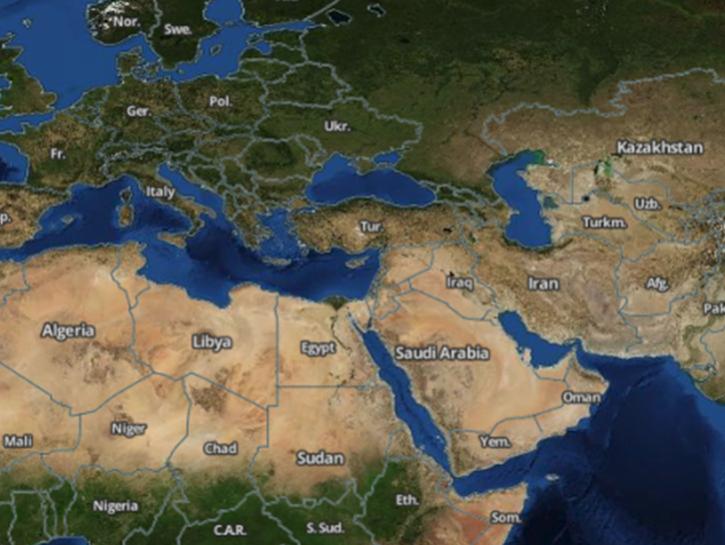
Dust storm over the Persian Gulf
Pictured on May 16, 2013, from Aqua/MODIS. Visit LANCE for more near real-time data products from EOSDIS.
Biomes in the Balance
The American Southwest region is as ecologically diverse as it is vast and researchers have been studying carbon cycling and storage in the region. Utilizing MODIS and Landsat imagery, researchers set up a network of flux towers in different biomes and across varying elevations. The flux towers measures a range of data, like carbon dioxide in the air, precipitation, temperature, and energy exchange. The information gathered from the towers and other in-situ information will go a long way toward helping scientists understand just how much carbon similar biomes can absorb, both locally and globally.